Judith Slaying Holofernes
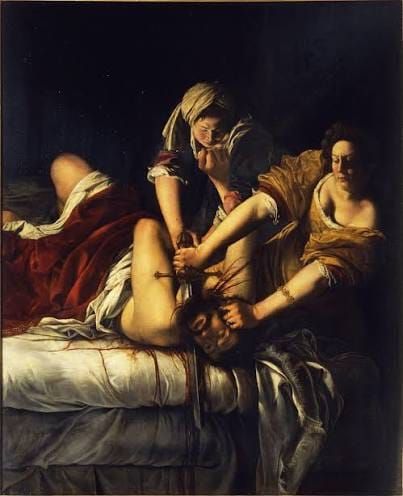
One of my favourite paintings, and my favourite rendition.
Artemisia Gentileschi, a post-Renaissance painter, like her Tuscan father, became a notable artist in an age where the fine arts — like most things — were reserved for men.
This woman, through hardship, extraordinary talent, and sheer grit, was accepted into the Florence Academy of Fine Arts against all odds, and later painted for the Medici family.
She was buried in name for around four hundred years before her works resurfaced and earned the recognition she so much deserved.
Caravaggio painted this same scene decades before Artemisia, and while his painting is masterful, the subjects can be found lacking her intent.
Which we see portrayed in the latter version.
Two women hell-bent on decapitation. Bitter fury depicted exquisitely in the faces of Judith and her maid. Sleeves rolled up — not for cleanliness, but for ease of severing stubborn ligaments.
The regard in his eyes could only have been rendered by a woman with a homicidal death-wish, and the contorted sheets painted in a way only a well-rehearsed fantasy could furnish.
Gentileschi had been a victim of rape, and understood too well the desire to take the life of another. She threw a blade at him after the crime in question, and he was banished from Rome for five years after being found guilty — though it is not certain the meagre punishment was ever fulfilled.
Artemisia was then married off to prevent incurring further shame to the family name, to a man who was a poor husband.
There's always insult to injury.
I come back to the arterial spray each time — painted in such a fashion that I go as far as empathising completely with what this woman felt when she expressed herself on this canvas.
Me too, Artemisia.
Me too.