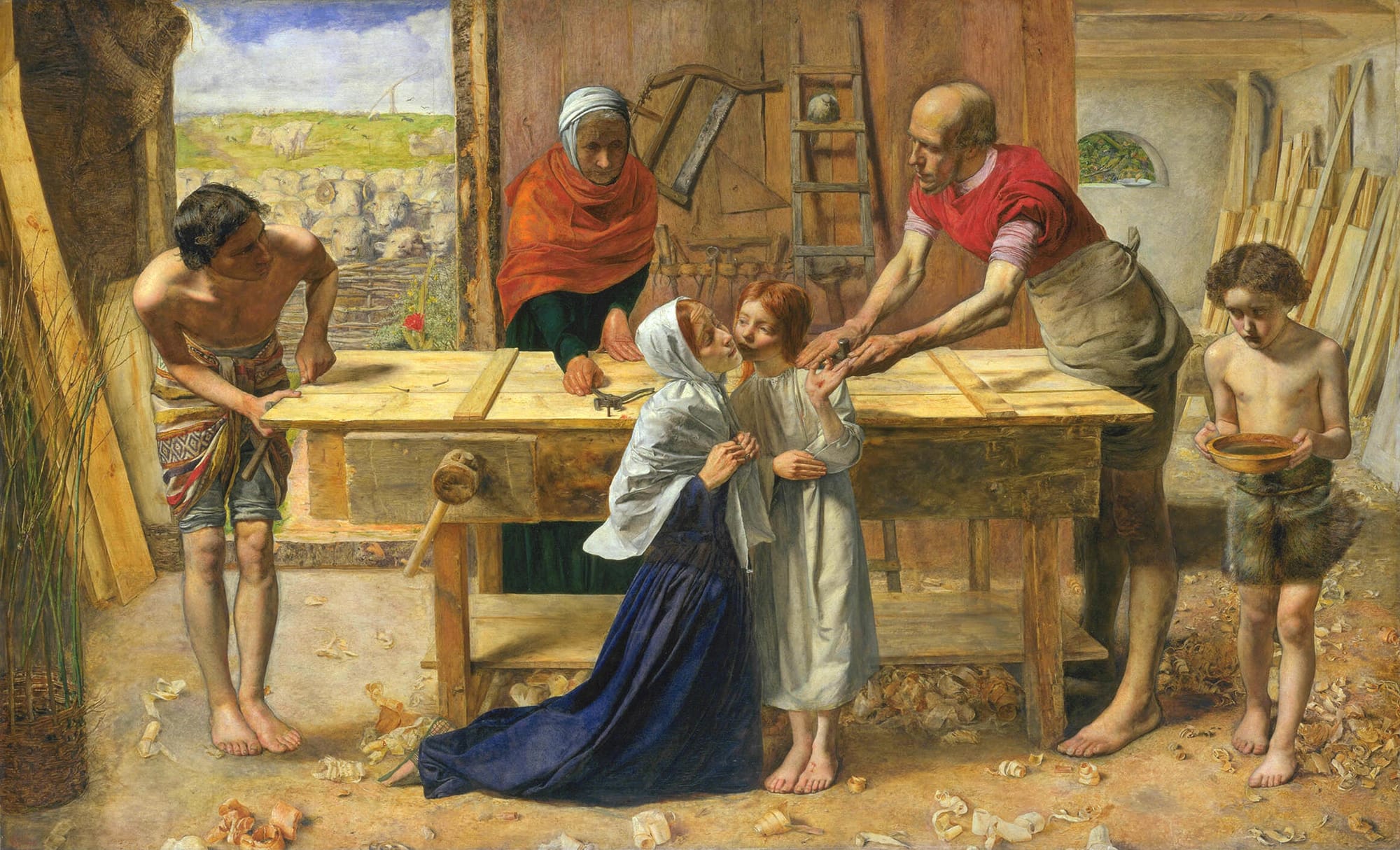
Painting: Christ in the house of his father
This painting was branded onto my retinas almost seven years ago now. A painting so right it's almost wrong.
In the carpenter's workshop, we find Joseph tending to his son — inspecting the wound, the premonition written in the palm of the child who would become the Christ. It is not a dramatic scene. It is a Tuesday. And that is precisely what disturbs you.
To the side, we find John — not yet the Baptist — making himself smaller than the central figure, almost as if by instinct. The bowl he carries is full of water, which we can only assume is to wash away the blood of his cousin. He offers it the way children offer things — earnestly, and slightly too late.
Every time I encounter this painting, I can't help noting how feminine the young Jesus appears. How peculiar he seems in contrast to his family. Meek, pale, almost waif-like. We could go as far as docile. A lamb of a child — and note the flock visible outside, as if Millais wanted to make sure you didn't miss it. He stands barefoot, like his cousin, in the middle of a builder's workshop, wearing only a light robe. Dressed, essentially, for another world entirely.
And directly above their heads — a triangle. A right-angled triangle, sitting quietly amongst the other tools.
Then there is Mary. Receiving a kiss from her child, not giving one. As though it is the mother who needs reassurance, not the wounded boy. She presses her cheek to his and closes her eyes, and you understand immediately that she already knows. Has always known. Is simply trying to hold the moment a little longer than it will allow.
How odd. A day in the life of a child prophet, carrying no honour in his own home. The wound already there, before any of it. Before the ministry, before Jerusalem, before the word was made anything. Just a nail, a palm, and a mother who already knew.